Matthew Mayich stepped onto the field of Sun Angel Stadium in Tempe, Arizona, at about 7 a.m. on August 20. It was the standout hockey player’s first official practice with his new team, and temperatures were already in the mid-80s.
He and his Arizona State University teammates spent at least 45 minutes doing push-ups, planks, flutter kicks, bear crawls, squats, sprints, and buddy-carries, led by guest trainer and former Green Beret Tim Ziesel. Before leaving the field, Ziesel gave instructions for one final exercise: a medicine ball run.
As temperatures approached 90 degrees Fahrenheit, the players set off in small groups, according to the university’s timeline of events. Mayich appeared to struggle, then stumbled, dropped the ball, and fell. He tried to rise and fell again.
Athletic staff treated him with iced towels and cool water, then sprayed him with a garden hose. Initially responsive, his condition deteriorated, and the trainer called 911. Paramedics rushed him to the hospital, where he remains in critical condition after experiencing what his family’s lawyer, Robert Carey, called exertional heat stroke. Carey did not respond to requests for additional information about the diagnosis, which could not be independently corroborated. He has told journalists the family’s hope for a meaningful recovery hovers near a miracle.
“We want accountability for what happened to our son,” Mayich’s parents, John and Christina, said in a written statement. “We want the truth.”
University officials declined to be interviewed, and Ziesel’s attorney, Larry Kazan, downplayed the intensity of the training session. “The workout was not difficult as some media outlets have attempted to color it,” he wrote in an email to Grist. Head coach Greg Powers insisted during a September 23 press conference that he was still the “right guy’” to lead the team but did not address specifics of the workout. ASU put him on paid leave Wednesday, more than a month after the workout and two days after seven of Mayich’s teammates impugned the school’s report and response in an anonymous letter sent via an attorney. Among other things, they said the workout lasted 75 minutes, not 45, and alleged that the university did not follow its own guidelines.
“The precautions required by ASU’s heat policy were not in place: no immersion tub, no ice chests, no on-field heat measurement, no scheduled breaks in shade,” they wrote, noting that the session “continued after some of us showed signs of distress, including dropping to a knee, vomiting and, in Matthew’s case, visible disorientation well before the final task.”

A St. Louis Blues prospect, Mayich, 21, had transferred to Arizona State to continue his college career. Instead, he is the latest in a long line of heat-related athletic tragedies that includes NFL player Korey Stringer, who died of heat stroke 25 years to the month before Mayich’s hospitalization. His death propelled heat safety into the national consciousness.
“We have made tremendous progress since then,” said Doug Casa, an exercise physiologist and certified athletic trainer. He is the CEO of the Korey Stringer Institute, which was established in 2010 to focus on safety and injury prevention for athletes, laborers, and warfighters. But he said Mayich illustrates that more can be done to protect players.
Exertional heat stroke is a life-threatening condition that occurs when the body overheats and cannot cool down. It’s a leading cause of preventable sports deaths, and the risk is rising as climate change has made extreme heat more frequent, intense, and prolonged. Between 1994 and 2026 — the two times the United States hosted soccer’s World Cup — World Weather Attribution found that the chance of extreme temperatures “at least doubled” in multiple cities. Grass fields have also increasingly given way to synthetic turf, which absorbs enormous amounts of heat. The surface temperatures at a recent Tennessee Titans football game in Nashville hit 157 degrees. One player rolled his ankle after the heat effectively melted his cleats, ESPN reported. “It was hot as s—,” said another. “I didn’t play a snap, and I had to get an IV.”
Whether it’s an NFL star or a t-ball tot, athletes nationwide are facing this new reality. Some organizations have responded remarkably effectively — Georgia high schools instituted policies that moved them from the deadliest state for football players to among the safest. Others rely on vague recommendations and limited mandates that leave athletes at risk. And many policies don’t address non-athletes who are exposed to the same conditions. Just a week after Mayich’s hospitalization, University of Iowa band member Derek Phillips collapsed during a football game played in temperatures that topped 90 degrees. He later died.
The policy landscape is full of holes, Casa said. Although best practices for preventing and treating heat-related illnesses in athletes are now largely established, consistent adoption and implementation is another matter. “A lot of times they know the right thing to do, but then they don’t do it in the time of crisis,” he said. “Heat stroke can happen at any time.”
The Minnesota Vikings picked Korey Stringer in the first round of the 1995 draft and by 2000 he was selected to the Pro Bowl. The following summer he reported to training camp as one of the best offensive linemen in the NFL. By Minnesota standards, though, the temperatures were scorching and Stringer struggled.
He vomited three times on the first day and left practice early to cool down in an air-conditioned trailer. The next day the heat index — a measure of temperature and humidity — hit nearly 100 degrees, but Stringer, despite vomiting again, completed the session. During a post-practice workout, he slipped, fell on his back, and was brought back to the air-conditioned trailer. He lost consciousness and was taken to the hospital, where doctors recorded an internal temperature of 108.8 degrees. He died of multiple organ failure thirteen hours later. He was 27 years old.
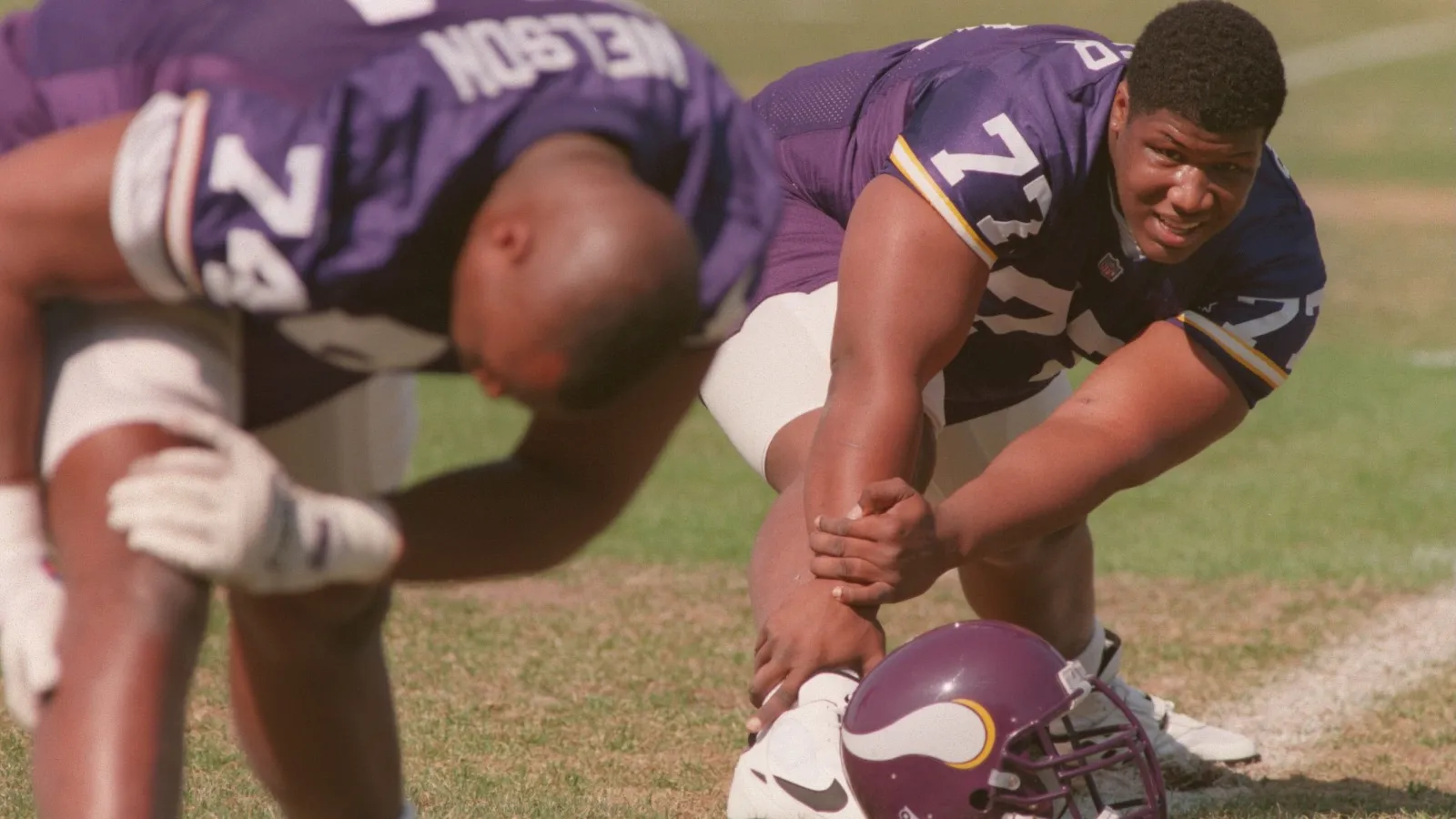
“It was a catastrophic failure in treating Korey,” said Casa, who was an expert witness in the litigation that followed Stringer’s death, and in numerous other cases. “If they had treated him properly, he probably would have had dinner with his teammates that night, or at least been back to normal the next day. That’s how simple it is.”
Research by Casa and others has found that cold-water immersion is the most effective treatment for heat stroke, and is faster at cooling than air conditioning, which the Vikings relied on. Casa said that reducing Stringer’s temperature enough to save his life would have taken well over an hour with AC, compared to about 25 minutes in an ice bath. “The cooling rates are astronomical,” said Casa. “We get their temps down so fast.”
The NFL would not provide a copy of its heat policy, but it did highlight the strengths of its protocol. Immersion tubs, for example, are required when hot weather is a possibility, as are rectal thermometers, which are necessary for diagnosing heat stroke. It also requires teams to adhere to best practices outlined by the Korey Stringer Institute, submit a plan for third-party review, and rehearse how they respond to emergencies. Exact interpretation is often left to each team or facility to allow flexibility, the league said, and clubs are encouraged to implement additional precautions whenever they feel there is a risk of heat issues.
“I don’t think we have ever had a case where a team didn’t comply,” said Allen Sillis, the league’s chief medical officer. “The NFL has really taken a leadership role since Korey Stringer’s death.”
Professional sports have largely standardized how they measure heat risk. Weather reports typically include temperature and heat index, which accounts for humidity. But the gold standard for measuring heat stress is wet bulb globe temperature, or WBGT, which also considers wind, sunlight, and radiant heat. “WBGT is a much better indicator,” explained Jordan Clark, the co-founder and chief climatologist at Klimo Insights, a heat safety and weather app.
Leagues still differ on their use of the metric. The NFL, for instance, requires teams to use WBGT but doesn’t specify exactly how. On the other hand, the National Women’s Soccer League mandates hydration breaks starting at a wet bulb globe temperature of 82.3 degrees and game delays when it tops 91.1 degrees. Teams that don’t comply can be disciplined or sanctioned. The NFL doesn’t enforce strict WBGT thresholds, so teams have the flexibility to invoke heat precautions more often.
Not everyone’s attempt to address heat has been well received. FIFA required water breaks during this summer’s World Cup, even in air-conditioned stadiums, prompting accusations that it was creating commercial breaks rather than protecting players. “We had FIFA basically make a mockery of heat rules for commercial value,” said Nicholas Watanabe, a professor of sport and entertainment management at the University of South Carolina. “Heat rules should exist specifically to protect people from heat.”
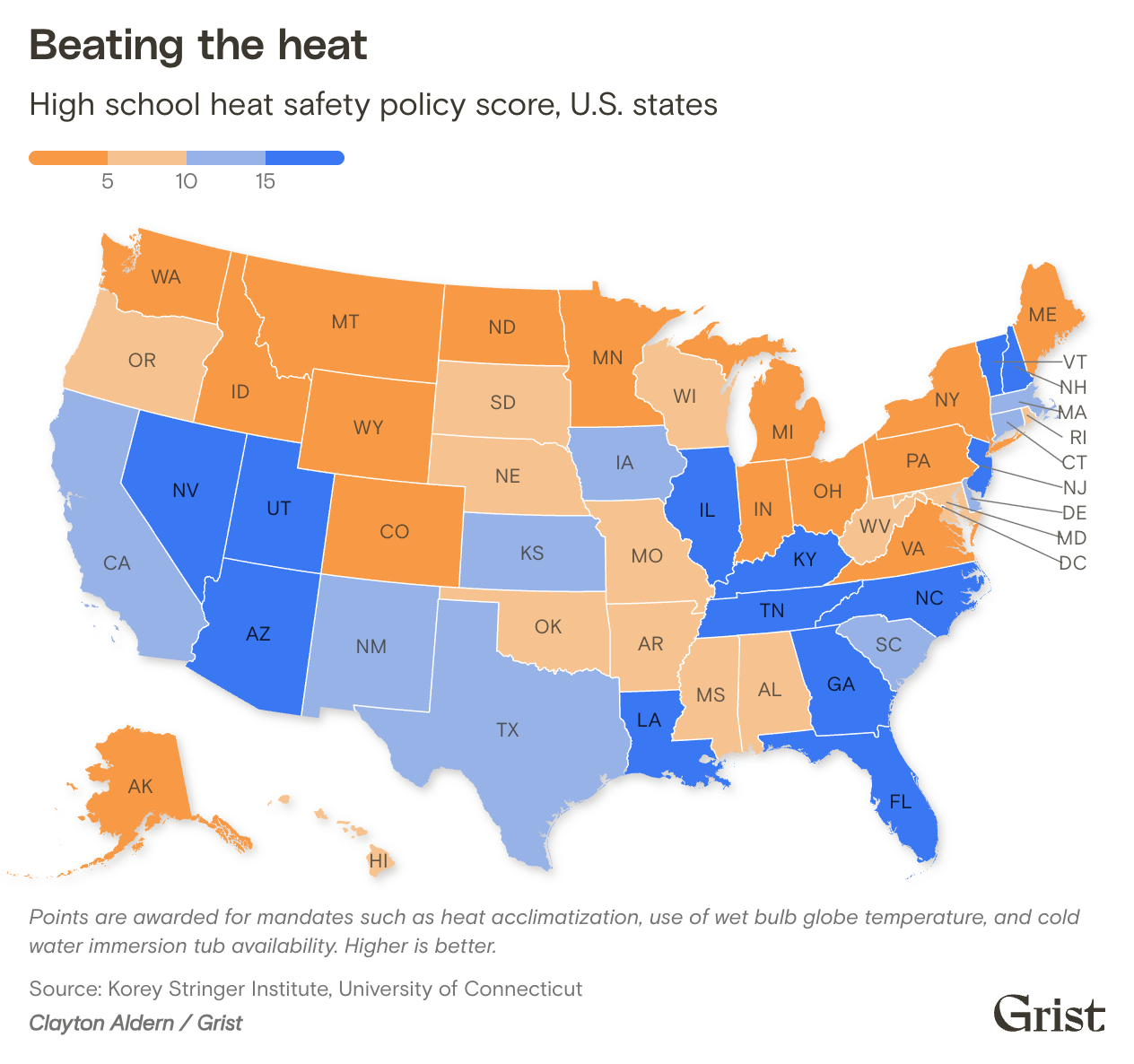
Policy differences aside, experts say professional leagues generally take heat seriously. The larger gaps emerge at lower levels. No federal regulations exist on heat safety in sports. Organizations like the National Federation of State High School Associations can and do provide guidance, for example, but states and even school districts can choose what to adopt. The Korey Stringer Institute has scored each state on its heat policies, awarding a maximum of 20 points for mandating things like requiring heat acclimatization, assessing wet bulb globe temperature, and making cold water immersion tubs available.